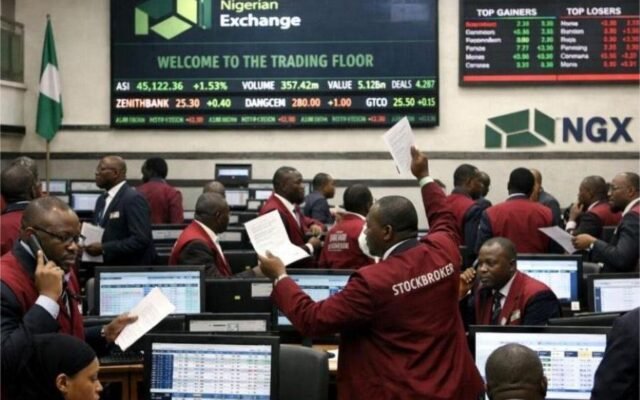
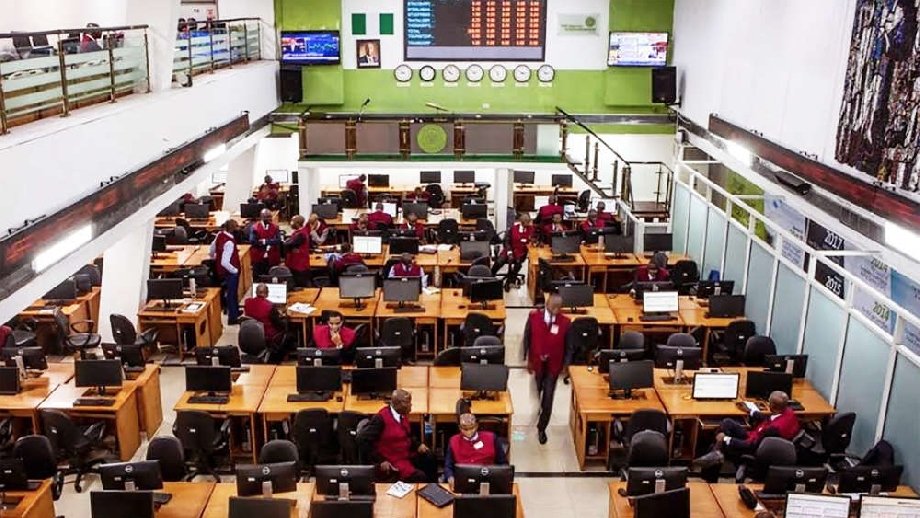
The total value of shares listed on the Nigerian Exchange rose by ₦2.64 trillion on Monday to reach a fresh record of ₦163.16 trillion, driven by renewed buying interest that lifted the All-Share Index 1.65 percent to 251,290.54 points. The increase marked one of the stronger single-day advances in market capitalisation this year and pushed the equity market to new highs.
Investors added substantial value across large-capitalisation stocks, with the industrial goods and banking sectors providing the main support. Dangote Cement advanced the maximum 10 percent daily limit to ₦1,222.10, while several banking names also posted solid gains. The industrial goods index rose 5.37 percent and the banking index gained 2.34 percent, helping the broader market overcome a negative breadth in which more stocks declined than advanced.
Market capitalisation had closed the previous week at ₦160.52 trillion. Monday’s jump of roughly ₦2.64 trillion therefore represented a clear recovery in investor appetite after a quieter stretch. The All-Share Index itself recovered the ground lost in the prior week and closed comfortably above the 250,000-point level that had briefly come under pressure.
Trading data showed that while the number of shares exchanged fell compared with the previous session, the value of transactions rose. This pattern typically occurs when activity concentrates in higher-priced stocks. Dangote Cement, First HoldCo, Nigerian Exchange Group and several banking counters featured among the more actively traded names, contributing both to the capitalisation increase and to the rise in turnover value.
The record market capitalisation reflects the cumulative effect of the strong year-to-date performance of Nigerian equities. The All-Share Index has delivered returns of approximately 61.5 percent so far in 2026, supported by a combination of improved corporate earnings in selected sectors, relatively firm oil prices and a gradual recovery in domestic investor confidence. The latest session extended that trend by adding another meaningful increment to total market value.
Analysts following the market noted that the concentration of gains in a handful of heavyweight stocks remains a feature of the current rally. Dangote Cement’s limit-up move alone accounted for a significant portion of the capitalisation increase. The performance of banking stocks provided additional breadth within the large-cap universe, yet the overall market breadth stayed negative, with 30 decliners against 24 gainers. This imbalance suggests that the upward move was selective rather than universal.
Honeywell Flour Mills, Royal Exchange and Nigerian Exchange Group also recorded sharp percentage gains, showing that interest was not confined solely to the very largest listings. These mid-cap advances helped support the broader narrative of renewed buying, even if the number of advancing stocks remained lower than the number of declining ones.
The session took place against a backdrop of ongoing attention to macroeconomic policy. The Federal Government has released a proposed economic policy framework for public consultation, while the Finance Minister has restated a medium-term target of single-digit inflation. These longer-term signals form part of the environment in which equity investors assess valuations and risk. In the near term, however, price action continues to be driven primarily by stock-specific factors and sector rotation.
Currency conditions provided a relatively stable backdrop. The naira traded near recent levels in the official window, while elevated oil prices continued to support sentiment toward companies with exposure to the energy and industrial sectors. Liquidity conditions in the money market have tightened in recent weeks, yet the equity market’s ability to attract buying interest indicates that domestic funds remain available for selected opportunities.
For portfolio managers and individual investors, the rise in market capitalisation translates into higher portfolio values for those holding the leading stocks. The ₦2.64 trillion increase is large enough to register meaningfully in performance numbers for the month and the year. At the same time, the negative market breadth serves as a reminder that not every stock participated in the advance, and that risk management remains important even in a rising market.
Looking at the technical picture, the All-Share Index has now established a new closing high. Market capitalisation has also reached a record level. Whether these highs can be sustained will depend on the continuation of buying interest, the release of further corporate results and the evolution of macroeconomic data in the coming weeks. A broadening of the advance beyond the current leaders would strengthen the case for further gains, while a retreat in the heavyweight stocks could reverse some of the capitalisation increase.
Trading volumes will also be watched closely. The decline in the number of shares exchanged on Monday, even as value rose, leaves open the question of how deep the current buying interest runs. Higher volumes accompanying further advances would provide more convincing evidence of broad participation.
The Nigerian equity market has delivered substantial wealth creation so far this year. The latest record in market capitalisation is the most recent expression of that trend. Investors will now look for confirmation that the renewed buying interest can persist and spread across a wider range of stocks in the sessions ahead.
Official market statistics and daily trading summaries are available from the Nigerian Exchange Group. Coverage of technology, fintech and financial market developments can also be followed on platforms such as Business Tech.
The combination of a record market capitalisation, a strong advance in the All-Share Index and leadership from industrial and banking stocks made Monday a notable session for Nigerian equities. The scale of the capitalisation increase underscores the sensitivity of total market value to movements in the largest listed companies and highlights the continued importance of those names in driving overall performance.