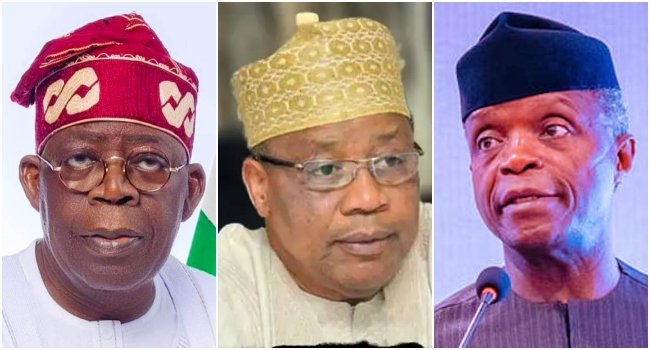
For decades, Nigeria’s political history has been defined by the shadow of military rule and the struggles for democracy. The June 12, 1993, presidential election remains one of the most controversial moments in the nation’s history, with its annulment sparking a political crisis that led to the rise of many key figures in modern Nigerian politics. Now, a fresh debate has emerged as President Bola Tinubu’s Special Adviser on Information and Strategy, Bayo Onanuga, has strongly dismissed Former Vice President Yemi Osinbajo’s assertion that former military ruler, General Ibrahim Babangida, was one of Tinubu’s tormentors.
The controversy began during the public unveiling of Babangida’s autobiography, A Journey in Service, at the Transcorp Hilton Hotel in Abuja last week. While reviewing the book, Osinbajo recalled how Tinubu, then a senator, opposed the dissolution of the Nigerian Senate by the military government in the aftermath of the June 12 election annulment. Osinbajo humorously remarked that Tinubu, who was supposedly tormented by the military—including Babangida—for trying to resist the annulment, was now present to honor one of his former oppressors.
However, Onanuga has now come forward to challenge this narrative, arguing that Babangida was never a tormentor of Tinubu. Speaking on Channels Television’s Sunrise Daily on Tuesday, the presidential adviser insisted that Osinbajo misrepresented history, clarifying that Babangida was, in fact, an inspiration to Tinubu rather than an adversary.
“I think the former Vice President got it wrong. Babangida was not really a tormentor of President Tinubu. Don’t forget that President Tinubu himself, in his extempore speech at the event, said that he held Babangida in high regard, that Babangida inspired him to get into politics,” Onanuga stated.
According to Onanuga, Babangida’s policy of promoting “new breed politicians” in the late 1980s and early 1990s encouraged professionals, technocrats, and private sector leaders like Tinubu to enter politics. He emphasized that it was this environment that paved the way for Tinubu’s political emergence, not oppression or persecution.
If not Babangida, then who were Tinubu’s actual tormentors? Onanuga pointed the finger elsewhere, clarifying that the real hostility against Tinubu and his political allies began under General Sani Abacha’s military regime. It was during this period that Tinubu and a group of senators made efforts to reconvene the dissolved Senate in Lagos—an act of defiance that led to intensified repression from Abacha’s dictatorship.
The debate surrounding Babangida’s role in Nigeria’s democratic journey has long been contentious. As the architect of the annulment of the June 12, 1993, election—widely believed to have been won by Chief MKO Abiola—Babangida has been criticized for stifling democracy at a crucial moment in Nigeria’s history. However, during his book launch, Babangida openly admitted that Abiola won the election, a rare acknowledgment from the former military leader. While many welcomed this admission as a long-overdue step, Onanuga remarked that it came too late to change history.
Babangida’s admission has reignited discussions about accountability and justice in Nigerian politics. While his acknowledgment of Abiola’s victory might be seen as a step towards national reconciliation, critics argue that words alone are insufficient without concrete efforts to address the consequences of that annulment.
For Tinubu, the legacy of the June 12 election and the democratic struggles that followed remain central to his political identity. He was one of the key figures who resisted military rule and later played a major role in Nigeria’s transition to democracy. His government has continued to emphasize the importance of democracy, and his advisers have been quick to counter narratives that distort or misrepresent his political history.
The clash between Osinbajo’s interpretation of events and Onanuga’s rebuttal reflects the complexity of Nigerian political history. In a country where past actions of political and military figures continue to shape present realities, the debate over who played what role in Nigeria’s democratic struggle is far from over. However, as Nigeria moves forward, there remains a critical need for accuracy in historical accounts, ensuring that lessons from the past are not lost in political rhetoric.
Stay informed with the latest news from Nigeria and beyond! Join us on WhatsApp or Telegram for real-time updates. Have a report or article? Send it to report@trendingnaijanews.com. Follow us on X (Twitter), Instagram, LinkedIn, YouTube, TikTok, and Facebook for more updates!