

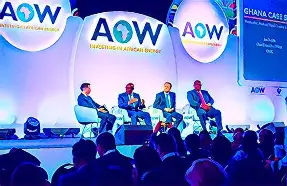
Africa Oil Week in Accra: Energy Leaders Confront Transition, Policy Shifts and Investment Challenges
The 2025 edition of Africa Oil Week has opened in Accra, Ghana, marking the first time the continent’s premier energy gathering is being held in West Africa after decades in Cape Town. The relocation has added symbolic weight to a conference that is being described by participants as “closer to the action” and more representative of the region’s growing role in shaping the future of global energy.
For industry leaders, investors, and policymakers, the mood has been described as both optimistic and urgent. With mergers and acquisitions, new licensing rounds, capital raising, and technical sessions at the forefront, the meeting in Accra has become a crucible for negotiating Africa’s place in a world caught between fossil fuel reliance and the demands of a low-carbon transition.
Chinadu Dwal, Vice Chair of the African Energy Council, speaking on the sidelines of the conference, summed up the atmosphere as “electric.” He emphasized the significance of hosting the event in Ghana, not only because it brings the conversation closer to major West African producers like Nigeria, Ghana, and Côte d’Ivoire, but also because it signals Africa’s intention to claim a greater voice in defining its energy destiny.
Mergers, Acquisitions, and Capital Flows
One of the most prominent themes this year is consolidation. “M&A is a big theme for 2025,” Dwal noted. Across the continent, companies are pursuing acquisitions and farm-in deals to strengthen portfolios and optimize resources. With several licensing rounds expected to be announced in Accra, investors are looking for opportunities to access unexplored or underexplored basins, including Ghana’s promising Voltaian Basin.
The conference has also emerged as a critical platform for capital attraction. African producers are showcasing opportunities to financiers ranging from Afreximbank to the African Development Bank, alongside global banks and private equity funds. This year’s focus, insiders say, is on raising development capital for frontier projects while also securing funding for midstream and downstream infrastructure.
Technical Depth in an Investment-Heavy Gathering
While Africa Oil Week in Accra has historically been labeled a “deal-making hub,” 2025 brings an unusual emphasis on technical deep dives. Sessions are expected to explore reservoir studies, seismic analysis, and the engineering of frontier basins. “Sometimes we get lost in the deals and the capital,” Dwal observed, “but the technical foundations are equally important. This year there will be serious technical work on what’s happening in specific basins and how to extrapolate that to the next phase of development.”
The Transition Debate: A Slowing Narrative
Central to the discussions is Africa’s place in the global energy transition. While international headlines remain dominated by climate commitments, many African stakeholders believe the urgency has slowed in practice. “There’s a tension between monetizing natural resources and doing it responsibly,” Dwal explained. “But over the last few years, the narrative has slowed down.”
Several factors underpin this slowdown: unrealistic targets set by international institutions, pushback from African governments, and shifting positions among global financiers. The U.S., under Donald Trump’s return to the White House, has relaxed some transition-driven restrictions. Global banks, once aggressive in divesting from hydrocarbons, are recalibrating. As capital returns to oil and gas, African producers see an opening to monetize their reserves while still seeking ways to embed environmental and social responsibility.
Nigeria’s Proposed Amendments to the Petroleum Industry Act
The Nigerian delegation arrived in Accra with policy reforms under scrutiny. Abuja recently announced proposed amendments to the landmark Petroleum Industry Act (PIA), shifting certain roles and powers between institutions.
Under the changes, the Nigerian Upstream Petroleum Regulatory Commission (NUPRC) would assume greater authority, not only as regulator but also as commercial representative of the Nigerian state in joint ventures and production-sharing contracts. Traditionally, that role belonged to the Nigerian National Petroleum Company Limited (NNPCL).
“This creates a player-referee situation,” Dwal noted. On one hand, the shift could plug financial leakages, curb over-invoicing, and strengthen fiscal discipline. On the other, it raises governance concerns. By consolidating regulatory and commercial authority in NUPRC, Nigeria risks undermining investor confidence.
The amendments also transfer ownership of NNPCL fully to the Ministry of Finance Incorporated, sidelining its independent board. Observers warn that such a move introduces bureaucracy and political interference, threatening NNPCL’s ambition of a public listing by 2028. “From a financial standpoint, the reforms could create transparency. But from a governance standpoint, they pose real risks,” Dwal cautioned.
Investor Confidence in Question
For investors, predictability and independence are critical. Shifting NNPCL’s commercial role to NUPRC and tethering its finances directly to the Ministry of Finance may ensure revenue transparency, but it complicates operational dynamics. Oil and gas investment decisions, often worth billions, require clarity on governance structures and assurance of limited political interference.
“This setup makes IPO ambitions very difficult,” Dwal said. “You don’t attract top dollar when investors see excessive government control. It risks turning away the very capital Nigeria hopes to attract.”
The Continental View: Preparing for Declining Oil Demand
Beyond Nigeria, African producers face a long-term structural challenge: declining global demand for crude oil. Forecasts suggest that demand destruction could accelerate by the 2030s as electric vehicles, renewable energy, and decarbonization policies expand.
For resource-dependent countries like Nigeria, Angola, and Equatorial Guinea, this means an urgent need to rethink economic models. “We must retain more value from what we produce,” Dwal argued. He pointed to the Dangote Refinery in Lagos as a step in the right direction. By refining locally, Nigeria captures value in jobs, taxes, and downstream industries instead of exporting raw crude and importing expensive refined products.
The refinery has already exported finished products to the United States, Saudi Arabia, and Singapore, retaining value at home while participating in global trade. For Dwal, this is the template for Africa: capture the full value chain domestically rather than remaining trapped in a commodity cycle dictated by global prices.
Carbon Regulation on the Horizon
Even as Africa seeks to maximize oil and gas value, regulatory headwinds loom. Europe’s Carbon Border Adjustment Mechanism (CBAM), which taxes imports based on carbon intensity, could affect African exports. Producers must adapt operations to remain competitive in a carbon-constrained world.
“This is already in effect in Europe,” Dwal warned. “If African exporters don’t internalize this, their products will face punitive taxes. We must anticipate this and adjust strategies accordingly.”
Balancing the “E” and the “S” in ESG
The ESG agenda—environmental, social, and governance standards—remains a critical lens for global investors. Dwal underscored that Africa must not only meet environmental criteria but also focus on the social component. “The S is often overlooked. Returning value to the general population is what will ultimately justify oil and gas development. If our people don’t see the benefits, then we’ve failed.”
A Region in Transition
As Africa Oil Week continues in Accra, the themes of governance, capital, and transition converge on one urgent question: how can Africa monetize its resources responsibly, attract capital, and prepare for a world that may consume less oil?
For now, optimism prevails. Delegates highlight opportunities in new basins, deal-making across the continent, and the promise of domestic value retention through projects like the Dangote Refinery. Yet the concerns are real: investor confidence is fragile, global energy markets remain volatile, and the political choices African governments make today will shape whether the continent thrives in the transition or is left behind.
As Dwal concluded, “It’s about being clever, responsible, and forward-looking. Africa must play both the short game of maximizing current resources and the long game of preparing for reduced demand. The decisions we make in the next few years will define our future.”