

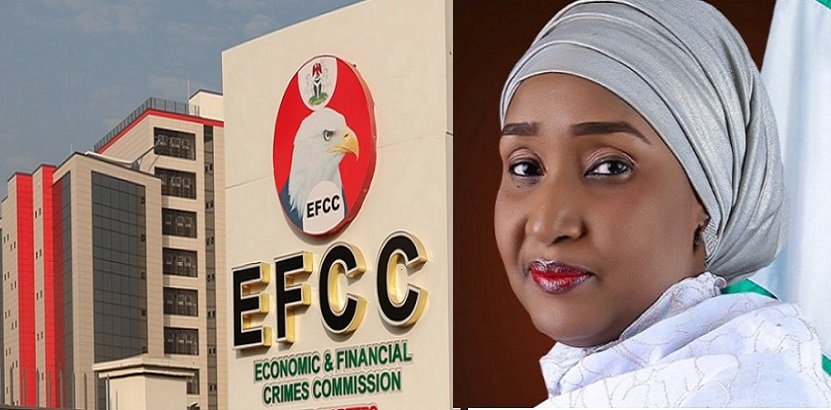
EFCC declares ex-Humanitarian Affairs Minister, Sadiya Farouq wanted
EFCC declares ex-Humanitarian Affairs and Social Development, Sadiya Umar Farouq, wanted over allegations of abuse of office and diversion of public funds.
The announcement was made public through a notice published on the agency’s official website on Saturday. In the notice, the anti-graft agency called on members of the public to assist with useful information that could lead to the arrest and investigation of the former minister.
According to the statement released by the commission, Farouq is 52 years old and hails from Zamfara State. The agency also listed her last known address as EN008, Okpo River, off Agulu Street, Maitama, Abuja.
The commission appealed to Nigerians who may have information regarding her whereabouts to contact any of its offices across the country. It also provided phone numbers and other contact details through which members of the public can communicate with the agency.
The EFCC explained that the declaration followed an ongoing investigation into allegations involving abuse of office and the alleged diversion of public funds during her time in office. Although the commission did not provide full details of the allegations in the notice, the development has attracted widespread public attention because of Farouq’s previous role in the administration of former President Muhammadu Buhari.
Farouq was appointed as Minister of Humanitarian Affairs, Disaster Management and Social Development in July 2019 by Buhari shortly after he began his second term in office. At the time of her appointment, she was regarded as one of the youngest ministers in the federal cabinet.
During her tenure, the ministry handled several important social intervention programmes aimed at reducing poverty and supporting vulnerable Nigerians. These programmes included initiatives focused on cash transfers, humanitarian support, disaster relief, and youth empowerment across different parts of the country.
However, in recent years, the ministry has faced increasing public scrutiny over the management of funds allocated to various programmes. Questions were raised by critics, civil society groups, and lawmakers concerning transparency and accountability in the handling of public resources.
The latest action by the EFCC comes after legal proceedings involving the former minister earlier this year. Recall that on April 16, 2026, a Federal Capital Territory High Court sitting in Apo, Abuja, reportedly issued an arrest warrant against Umar Farouq. The court order was said to be connected to allegations brought before the court as part of ongoing investigations into financial misconduct.
The development marks another major anti-corruption case involving former public officials in Nigeria. Over the years, the EFCC has investigated and prosecuted several politicians and former government appointees accused of financial crimes, abuse of office, money laundering, and diversion of public funds.
The declaration of Farouq as wanted has sparked reactions from Nigerians on social media and within political circles. While some people have praised the anti-corruption agency for continuing its investigation, others have called for due process and urged authorities to ensure that the case is handled fairly and transparently.
Legal analysts say the next steps in the matter will likely involve efforts by security agencies to locate the former minister and ensure that she appears before the court. If arrested, she may be required to respond to the allegations and face legal proceedings in accordance with Nigerian law.
Read More: Fubara missing as APC screens 14 govs, Tinubu’s challenger
As of the time of this report, there has been no official public response from Farouq regarding the allegations or the declaration issued by the EFCC. Her legal representatives have also not released any formal statement addressing the matter.
The case is expected to remain a major topic of national discussion, especially because it involves a former member of the federal cabinet and concerns allegations tied to public funds meant for humanitarian and social development programmes. Many Nigerians are now closely watching the outcome of the investigation and the legal process that will follow in the coming weeks.