

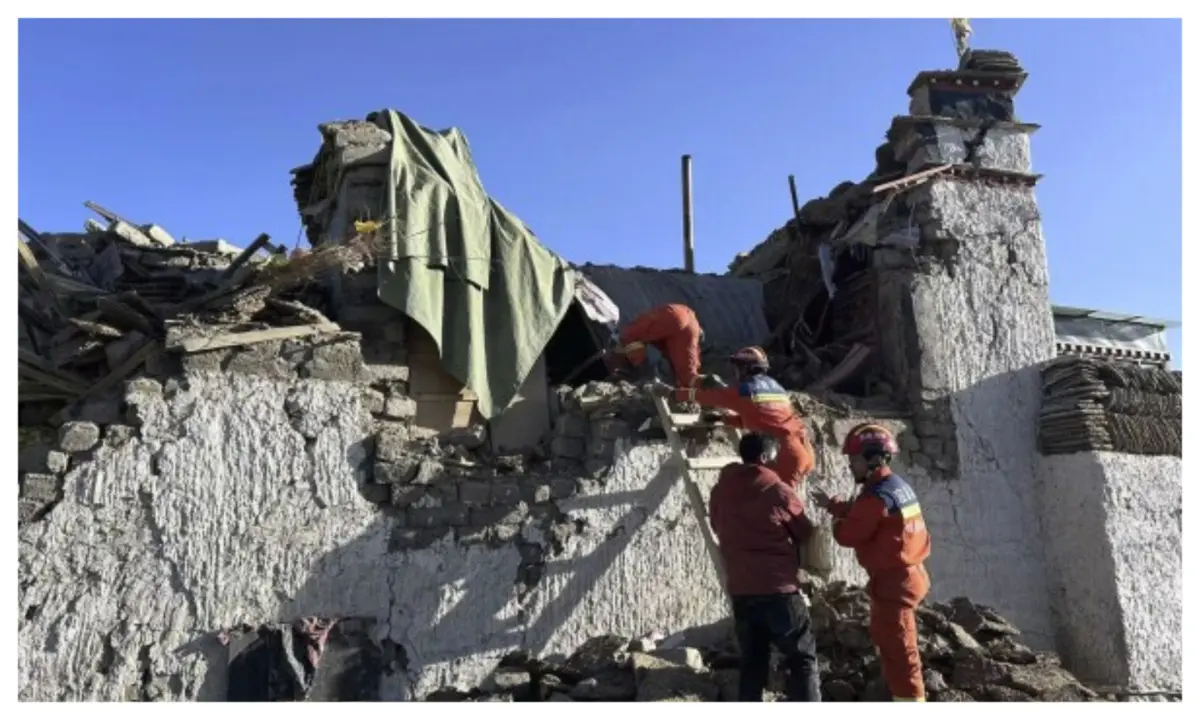
A powerful earthquake struck China’s Tibet region on Tuesday, killing at least 53 people and leaving widespread destruction in its wake. The tremor, which registered a magnitude of 6.8 according to the China Earthquake Networks Center (CENC), hit Dingri County near the Nepal border at 9:05 a.m. (0105 GMT). The U.S. Geological Survey reported the quake as a magnitude 7.1.
State media released harrowing images of crumbled buildings and rubble-strewn streets, revealing the quake’s catastrophic impact. Rescue teams are racing against time to assess damage and reach affected areas in Dingri County, a high-altitude region near Mount Everest with a population of about 62,000.
Initial reports confirmed 32 deaths and 38 injuries shortly after the quake. As the day progressed, the toll rose to 53, according to Xinhua News Agency. Many buildings near the epicenter have collapsed, leaving hundreds homeless. Temperatures in the area have plunged to minus 8 degrees Celsius (17.6°F) and are expected to drop to minus 18, complicating rescue efforts.
Tremors from the earthquake were felt in Nepal’s capital, Kathmandu, and regions near Everest, as well as parts of India. In Nepal’s Namche region, government official Jagat Prasad Bhusal reported strong shaking that startled residents. Fortunately, no casualties or damage were reported in Nepal or India.
Dingri County, situated on the Chinese side of Mount Everest, frequently experiences seismic activity. However, Tuesday’s quake is the most powerful recorded within a 200-kilometer radius in the last five years.
The disaster evokes memories of previous deadly earthquakes in the region. In 2015, a 7.8-magnitude quake devastated Nepal, killing nearly 9,000 people and displacing thousands. Similarly, a December 2023 earthquake in China’s Gansu province killed 148 people and left survivors struggling in freezing conditions.
As rescue teams work through the rubble in subzero temperatures, survivors in Dingri face an uncertain future. The tragedy highlights the vulnerability of communities in the seismically active Himalayan region, where tectonic activity remains a constant threat.
China’s state disaster relief teams, bolstered by local authorities, are mobilizing resources to provide aid and shelter. However, the freezing weather and remote location of the epicenter make this a challenging operation.
The region remains on high alert as aftershocks continue to rattle the area, adding to the tension and fear among residents.