

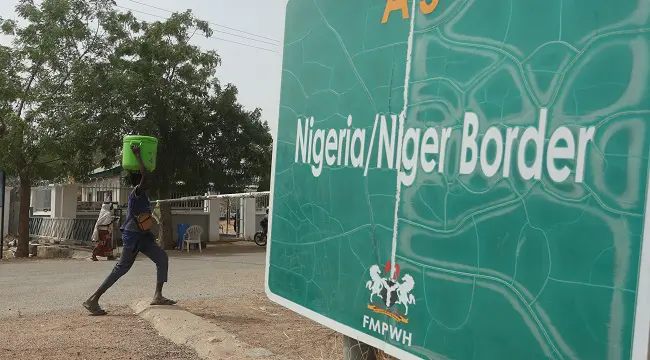
Former Governor of Niger State, Dr. Mu’azu Babangida Aliyu, has expressed doubts about the effectiveness of Nigeria’s border closure policy, stating that it has had little impact on trade and the movement of goods within the ECOWAS region. He also underscored the pressing need for educational reforms in northern Nigeria.
Speaking at the 22nd Daily Trust Dialogue held at the NAF Conference Centre in Abuja on Thursday, Aliyu questioned the rationale behind the border closure, noting that Nigerian goods continue to dominate markets in neighboring ECOWAS countries.
“What is the importance of closing borders?” he asked. “What is the importance of that while the population of Nigeria is almost the population of other ECOWAS members? And every market you go to in ECOWAS countries, you will discover that more than half of the things in that market are from Nigeria.”
He highlighted that despite the border policy, certain goods remain more affordable in neighboring countries than in Nigeria.
“For example, in Niger, the cow is still cheaper than in Nigeria. Apart from the inflation, it has always been like that because we used to send people there on good days to get these cows either for slaughter or Sallah. Why is this so? Please, do what you have to do,” he remarked.
Aliyu also turned the spotlight on education, lamenting the dire state of the sector in northern Nigeria. He pointed out the alarming shortage of qualified teachers in the region.
“The second thing I am pursuing is education. In the northern states, there is no state with 50% qualified teachers,” he said.
He urged the federal government to utilize specialized universities to address the educational gap.
“Use federal universities of agriculture and universities of education to educate people. We need education to have people who are passionate about a particular thing,” Aliyu emphasized.
The former governor stressed that addressing the educational crisis is vital to tackling the region’s developmental challenges, calling for urgent action to improve the quality of teaching and learning in the north.