
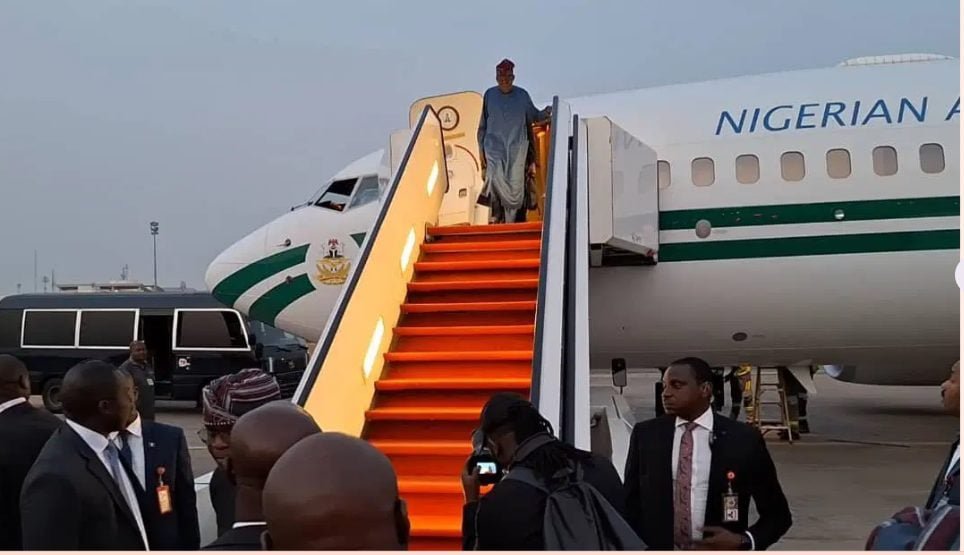
Nigeria’s President, Bola Ahmed Tinubu, has arrived in Addis Ababa, Ethiopia, to participate in the 38th Ordinary Session of the Assembly of the African Union (AU) Heads of State and Government.
The high-profile summit, which gathers African leaders and key policymakers, aims to address pressing continental issues, including security challenges, economic development, and justice for Africans through reparations.
Tinubu landed in Ethiopia on Thursday night and was warmly received by top diplomatic officials, including Ethiopian Deputy Chief of Protocol, Eshetu Legesse, Nigeria’s Minister of Foreign Affairs, Yusuf Tuggar, and the Chargé d’Affaires of the Nigerian Embassy in Ethiopia, Nasir Aminu.
Shortly after his arrival, Minister Tuggar briefed Tinubu on key agenda points for the summit, highlighting Nigeria’s diplomatic strides and the nation’s role in shaping discussions on security and economic policies in Africa. The briefing, which lasted into the early hours of Friday morning, underscored a major diplomatic victory for Nigeria—the re-election of Ambassador Bankole Adeoye as AU Commissioner for Political Affairs, Peace, and Security.
Adeoye’s re-election is seen as a boost to Nigeria’s influence within the AU, reinforcing the country’s leadership in shaping policies on governance, conflict resolution, and regional stability.
The 2025 AU Summit, themed “Justice for Africans and People of African Descent Through Reparations,” will address the historical injustices faced by African nations and discuss efforts toward reparatory justice and racial healing.
Beyond the reparations debate, Africa’s security challenges will be a major focus, with particular emphasis on the worsening conflict in the Democratic Republic of Congo (DRC), insurgency threats, and peace-building efforts across the continent.
Tinubu is expected to deliver a key speech at the AU Peace and Security Council meeting, where he will outline Nigeria’s stance on regional security and propose solutions to ongoing conflicts in different parts of Africa.
Accompanying Tinubu to the summit are several high-ranking Nigerian government officials, reflecting the country’s commitment to active engagement in African affairs. Some of the key delegates include:
Wale Edun – Minister of Finance
Abubakar Badaru – Minister of Defence
Jumoke Oduwole – Minister of Trade and Investment
Festus Keyamo – Minister of Aviation
Muhammed Idris – Minister of Information and National Orientation
Balarabe Abbas Lawal – Minister of Environment
Doris Uzoka-Anite – Minister of State for Finance
Their participation is expected to facilitate bilateral discussions and agreements on trade, investment, security partnerships, and climate action initiatives.
As Africa’s largest economy and most populous nation, Nigeria continues to play a pivotal role in AU discussions on economic growth, regional peace, and political stability.
With ongoing security concerns, including terrorism in the Sahel, political instability in West Africa, and the humanitarian crisis in Sudan and the DRC, Nigeria is pushing for stronger collaboration among AU member states to address these issues through joint security operations, intelligence-sharing, and diplomatic mediation.
Nigeria’s commitment to continental development is further evident in its leadership in organizations such as ECOWAS, where the country has taken an active stance in addressing military coups and democratic governance in West Africa.
After participating in high-level discussions and delivering his address, President Tinubu is expected to return to Nigeria on Monday, February 17, where he is likely to brief the nation on the outcomes of the summit and how Nigeria will leverage its diplomatic position in Africa’s future policies.